Showing posts with label 1929. Show all posts

Friday, August 27, 2010

The Merry Dwarfs - December 16, 1929


The Merry Dwarfs is the 5th toon in the Silly Symphonies series. This film is definitely an interesting one...it can be found in the From the Vault section of its DVD.
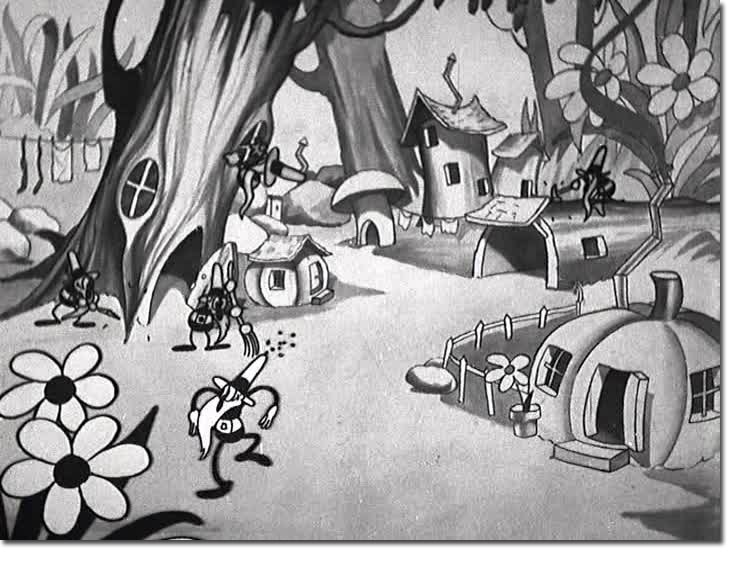

Tucked away in a magical forest is the home of the 3-inch tall merry dwarfs. These creatures who make homes out of pumpkins and mushrooms are really the first fairytale-like characters to be featured in the Silly Symphonies.


The dwarfs offer many opportunities for great gags. This dwarf is at first angry about breaking his broom (actually a leaf) until he discovers his long beard works just as well.


The resident shoemaker dwarf is busy creating 6 pairs of shoes for his sleeping customer...all while dancing merrily of course.


The blacksmiths create shoes for the village's rough and tough grasshopper. I enjoy these fanciful shorts because Disney has such a great way of dreaming up inventive ways to mirror regular society life.


The Merry Dwarfs is placed in the From the Vault section because it heavily features alcohol. The reason why the dwarfs are so merry is because they regularly down mugs of beer.


Through jolly dancing, the dwarfs are able to drink barrels of their own magical beer. All this beer of course causes some rather strange things to occur...


Funny dances and using daisies as May Poles are just some side effects of dwarf beer. This dancing should also indicate to you the animation style of Ub Iwerks.


These dwarfs showcase very interesting and creative forms of dancing...but then again that's to be expected after a few beers...


A rather giddy dwarf manages to use a leaf as a frilly and playful dress. This little scene actually is a great piece of solid animation.


One of the funniest moments in the toon comes when 2 dwarfs fall accidentally into a barrel of beer. As they emerge...


...they can't seem to stand straight. This is some great animation that has no boundaries as the dwarfs stumble here and there all over the screen.


The best part comes at the end of the short. The background starts to jumble and twist as the dwarfs become progressively drunker. It's a great effect!


The Merry Dwarfs is not an outstanding toon, but it is a very entertaining film to watch. The inclusion of an alcohol-related subject alone is a good reason to view this short. Great animation that is silly and entertaining makes this film a solid early Silly Symphony.

Wednesday, August 25, 2010

Hell's Bells - October 30, 1929

Hell's Bells is the fourth film in the Silly Symphonies series. It's an interesting, though rather macabre toon that shows great animation style.


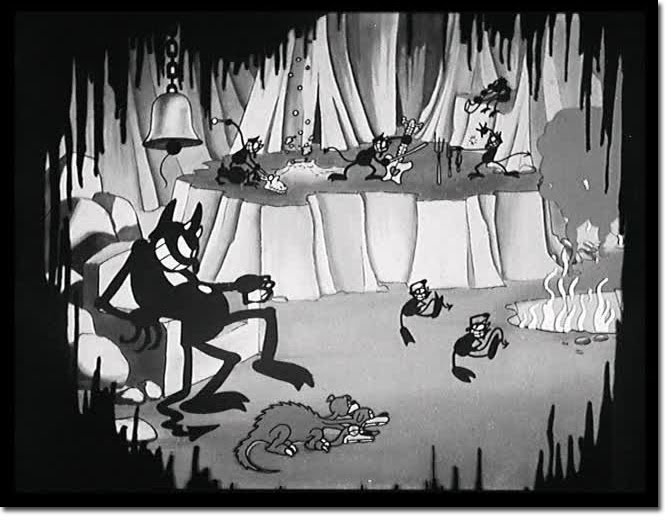
Hell's Bells opens rather dramatically as fire engulfs the screen to reveal a chamber of Hell. From around the fire pit emerges a hooded Grim Reaper character, setting the scene for evil mischief.


The set design for this toon is very well done. The cave surrounding the outer edges of the screen adds an amount of depth that allows the film to look more thematically appealing. It's a great touch.


Along with many of the early Silly Symphonies, the animation for this film was supplied mainly by Ub Iwerks. A true trademark of Iwerks' animation technique is the tendency for his characters to pop out at the audience. Here a spider swings towards the camera, eats the audience, and swings back into the center of the screen.


We are also introduced the Devil's pet, a three-headed canine. This creature is based on the mythological creature Cerberus who lives in the underworld of Hades. This character will of course be revisited by Disney years later in 1997's Hercules.


A great gag is presented here as a bat is eaten by some sort of demonic snake. The snake at once sprouts wings and flies away.


Finally the audience meets the head honcho himself, the Devil. It seems the Devil enjoys having entertainment in his chambers, as evidenced by his demonic band.


There's some great animation here as the band gleefully plays their bone instruments with sinister smiles plastered on their faces.


During the music, the demons begin to dance around the chamber. There's a great segment here involving a demon and his large shadow cast upon the wall. The precise way in which the shadow follows all the movements of the demon's dance is a great piece of animation in these early years of the Disney studio.


Much like the cartoons before it, Hell's Bells also showcases interesting dances involving a trio of characters. This seems to be a trend in these early Silly Symphonies.


Soon the Devil grows tired of entertainment and hungry for dinner. He rings the dinner bell as his demon servants milk a nearby dragon for yummy fire.


Pleased with the speediness of his servants, the Devil quickly downs his entire pot of delicious and hot flame soup.


One thing about working for the Devil is that you never know what he'll do next. One unlucky demon is plucked up and thrown to Cerberus for lunch.


The Devil orders the remaining demon to receive his fate; however, this demon was clearly not born yesterday. He promptly runs in the opposite direction, and a chase ensues.


Hiding under a cliff, the demon manages to confuse the Devil until he is able to kick him over the edge and into the pits of Hell.


The Devil tumbles down into the pit, but is able to find a cliff to hold on to for dear afterlife. However, the fires of Hell are hungry, and soon they take the Devil down into the depths of the Underworld.


Hell's Bells is a little gem of a toon . It's interesting to note that this Silly Symphony is really the first one to have the beginnings of some sort of story. Although that story didn't begin until the toon was more than half over, as time goes on the Silly Symphonies are able to find a true balance between showcasing music and presenting an entertaining story.


Tuesday, August 24, 2010

Springtime - October 24, 1929

The 3rd Silly Symphony cartoon is actually the first in a series of four toons focusing on the four seasons. Springtime is a playful musical film which acts as a true showcase of the amazing synchronization skills of the Disney studio.


The film opens on a forest scene with flowers and trees dancing playfully. It's hard not to compare the opening to that of Flowers and Trees, which also features nature dancing about. According to Daniel Goldmark, author of the book Tunes for 'Toons , the music used for the opening sequence is "Morning Mood", the popular tune from the Peer Gynt Suite No. 1.


As the flowers dance, one flower steps towards the camera to reveal bugs dancing on its petals.


Next we see a caterpillar dancing along the ground. His animation is very well done, and the gag of his body splitting is a good one. But of course this is nature, and soon the tasty caterpillar is gobbled up by a hungry bird.


The action then focuses on the bird and his family, including his wife and four children. As the bird dances about, his body stretches and squashes in very cartoonish ways. This is interesting because the Mickey Mouse cartoons started in this fashion, but had begun to move away from this technique. It did exist here and there in some cartoons, but for the most part Mickey was presented without the "rubber hose" effect.


What is interesting is that even though there are numerous animals in Springtime, only the mother and father birds wear any sort of clothing.


Being spring, rain is always just around the corner. A great gag is shown here as a lightning bolt screws a hole in a storm cloud and creates a deluge of water.


One older tree definitely enjoys his shower time, though being hit by lightning is not always the best feeling...


Once the rain has died down, the forest creatures start to come out from their hiding places. These grasshoppers enjoy dancing in the grass, so much so that they dance right into the open mouth of a hungry frog.


Longtime Disney animator Ub Iwerks worked on many Mickey Mouse and Silly Symphonies cartoons. His animation style is evident in this frog which bears a remarkable resemblance to Flip the Frog, a later character of Ub Iwerks.


The Silly Symphonies were used regularly as an experiment testing ground for new ways to use animation. A great example of this is the awesome water reflections created for the pond frog.


A great technique that is in much of Iwerks' animation is a character zooming into the camera in order to create depth. It's almost like an extremely primitive version of 3D.


This spider with one tooth appears here in this film for the first time. The character is used in future Silly Symphonies such as 1930's Midnite in a Toy Shop.


Soon the music wakes a crane up from its nap, and by the look of things it is on the prowl for lunch.


Meanwhile, the pond frogs begin to dance about on their log. The animation is strange to watch, as the frogs wear blank faces. This animation definitely is a reminder of The Skeleton Dance.


Soon however the fun is spoiled by the hungry crane. A great gag is shown here as the frogs smallest to biggest jump into each other's mouths.


The chase is on as the crane runs after the last remaining frog. The crane throws the tasty frog up into the air...


...and each frog previously ingested comes out in the sky. Gravity soon kicks in, and all four frogs become a great lunch for the crane.


The toon ends as the crane runs off on an empty stomach. It falls into a puddle of water, and with a crash the camera goes dark.


The action in Springtime is by no means terribly exciting; in fact the film really has no story. Even though the toon does seem dull by today's standards, it is really the marriage of music and animation that would have been most interesting and even revolutionary to audiences back in 1929. With that in mind, Springtime surely excels in its purpose to both amaze and entertain.


Friday, February 12, 2010

El Terrible Toreador - September 7, 1929

El Terrible Toreador is 2nd in the Silly Symphonies cartoon series, and unfortunately its name fits a little too well. Coming off the heels of the entertaining The Skeleton Dance, this film manages to pale in comparison with decent animation but nothing spectacular.


Notice the title cards used for this toon. Mickey Mouse makes an appearance here because he was an already a popular character. In a way he was used to endorse the Silly Symphonies until the series was able to make a name for itself.


El Terrible Toreador opens in a Mexican cantina with Carmencita, the cantina girl. This toon is an early attempt by the Disney animators at human characters. The effect though is not quite right, as the characters possess a "rubber hose" quality allowing their arms and legs to stretch.


The audience is next introduced to the Mexican officer who obviously has an eye for the lovely Carmencita.


In enters El Toreador, the best bullfighter in all the village. He is an instant crowd pleaser as he saunters through the cantina.


Carmencita is instantly infatuated by the handsome El Toreador, but the Mexican officer wants her all to himself. Here is a perfect example of the rubber hose quality given to these characters: the more the officer stretches Carmencita's arm, the thinner her stomach becomes.


Displeased with the officer's manhandling of Carmencita, El Toreador calls him out and saves the cantina girl.


The toon then abruptly switches to La Gran Corrida de Toros, the local bullfight. El Toreador enters the stadium with his bull.


In the stands, Carmencita claps for her lover while the officer looks on resentfully.


The actual bullfight turns out to be anything but. El Toreador and the bull dance, skip, and at one point are shown playing patty cake.


Determined to get his revenge, the officer sprinkles Carmencita's flowers with pepper just before she throws them into the ring.


As El Toreador and the bull smell the flowers, the pepper bothers the bull's nose. The bull sneezes so hard that he knocks his teeth out!


Once he has his teeth back in, the bull is mad! He goes after the first thing he sees, which happens to be El Toreador. The next scene is another example of Disney's tendency to have its animation pop out at the audience. As the bull chases down El Toreador, it runs straight towards the camera and almost eats the audience.


El Toreador is scared hairless of the approaching bull.


But in the end, El Toreador's bullfighting skills pay off as he manages to turn the bull inside out. El Terrible Toreador comes "From the Vault" on its DVD for this scene in particular; the sight of a bull with its innards exposed is not the best thing to show in any Disney toon.


El Terrible Toreador is a dysfunctional toon with no character development. It's not a very good follow-up to the superb The Skeleton Dance, making the toon a bit forgettable.